Concrete pavement installation is a process that starts with concrete preparation and ends with concrete curing. If you are interested in learning more about the concrete paving process, this blog post is perfect for you!
Concrete Preparation
Concrete combines cement, sand, water, and aggregate (gravel or crushed stone). The first step for concrete pavement installation is to mix all these ingredients. This includes adding water or other liquids called admixtures to create a concrete mix that can be poured into forms where it hardens and becomes solid concrete pavement.
Next, you need to ensure the surface where the concrete being installed has been graded so that there are no low spots or high areas; these could lead to cracks and potholes developing over time.
Concrete Base
The next step is the concrete base (or sub-base), which consists of gravel, crushed stone, or broken rock with cement mixed in between these materials. This provides stability for an even surface for the concrete pavement to go on top of it all. Once done, you are ready to start pouring concrete.
Concrete Pouring and Leveling
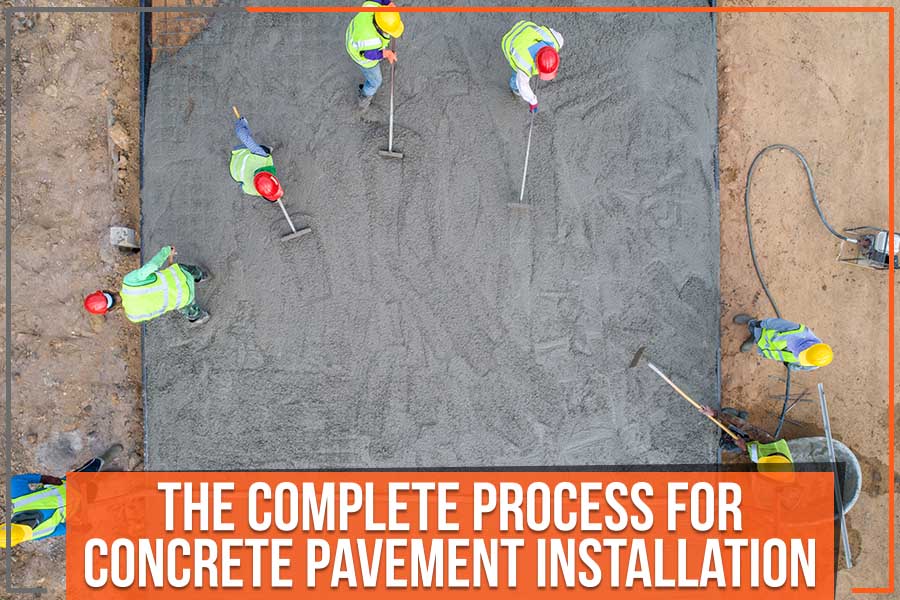
Concrete pavement installation can be done by a concrete truck. Immediately after pouring, some levelers will go through, ensuring your concrete has been appropriately poured and is even throughout. The next step is to break up any lumps in the concrete while it’s still wet using a concrete broom.
Concrete Curing – The Vital Process for Quality Concrete Pavement
When it comes to concrete pavement installation, a lot more goes into the process than just pouring some concrete. Once the slab has been poured and left to cure, many people stop paying attention – but this is actually when one of the most critical processes begins: curing. Curing isn’t just some fun word. It is an essential part of the concrete pavement installation process. While concrete is a solid building material, it requires at least 28 days to cure thoroughly!
Purpose of Concrete Curing
Curing keeps the concrete moist and at the right temperature so the cement can keep reacting with water (hydration), which is what builds its strength from air and water molecules trapped within them. This chemical process strengthens the concrete by producing calcium silicate hydrate (CSH), which bonds the cement and sand particles together. This results in concrete with much greater compressive strength, protecting the pavement from damage due to vibration. Once cured, concrete is more resistant to wear caused by weather conditions.
Prime Asphalt has the experience and knowledge to help you with all of your concrete paving needs in Waco, TX. We have been in business for years, so we know what it takes to produce a quality concrete surface that lasts for years without fail. To learn more about our first-rate concrete services, get in touch and get a free estimate while you’re at it!
Steps that make the difference: forms, steel and joints
Between base preparation and the pour, a few steps decide how well the slab performs:
- Forms are set to the finished height and slope so water runs off and away from buildings.
- Reinforcement, usually rebar or wire mesh, is placed as the design calls for and kept up off the base so it ends up inside the slab, not under it.
- Isolation joints separate the new slab from buildings, existing concrete and fixed objects so each can move on its own.
- Control joints are tooled or saw-cut to make the slab crack in straight lines at planned spots. A common rule of thumb is to space them, in feet, about two to three times the slab thickness in inches.
Finishing and curing in Texas weather
After placement, the concrete is screeded to grade, floated, edged and given a broom finish. The broom texture gives traction on driveways, sidewalks and ramps.
Texas heat and wind can dry the surface before the concrete has hardened, which leads to weak surfaces and fine cracking. In summer, crews often pour early in the morning and apply a curing compound or keep the slab moist. In winter, blankets keep new concrete from freezing.
Building on Blackland clay
Around Waco, Temple and south DFW, the clay underneath swells when wet and shrinks in drought. The slab holds up best with a well-compacted base, good drainage, the right reinforcement and properly spaced joints. Skipping any of those usually shows up as cracking within a few years.
Timeline at a glance
- Walking: usually after 24 to 48 hours
- Cars: about 7 days
- Heavy trucks: wait longer. Concrete reaches its design strength around 28 days.
See our concrete paving service for driveways, pads and walks. For lots and larger sites, see commercial paving and parking lot paving.
Related: Concrete vs. Asphalt: Which Is Right for Your Driveway or Lot? · What You Need to Know About Concrete Projects in Winter
Frequently asked questions
How thick should a concrete driveway be?
Four inches is common for passenger cars. Areas for heavy trucks, RVs or equipment need a thicker slab and a stronger base.
Why are there lines cut into the concrete?
They’re control joints. Concrete shrinks as it cures and will crack somewhere. Joints make it crack neatly in the groove instead of across the slab.
Should new concrete be sealed?
Sealing helps keep out water and stains. Follow the sealer maker’s timing, which is usually after the concrete has cured for a few weeks.
Will my concrete crack?
Some cracking is normal, which is why joints are placed. A good base, reinforcement and curing keep cracks small and in the joints.
Concrete or asphalt for my project?
Concrete costs more up front and needs less routine upkeep. Asphalt costs less and is easier to repair. Many properties use both, each where it fits best.
Get a free estimate. Planning a concrete project? Contact us for a free estimate.